
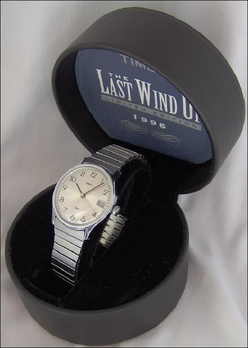
 For those old enough to remember the advertising campaigns of the 1950’s and 60’s, the Timex brand was reborn with the assistance of John Cameron Swayze. The company had its roots in Waterbury, Connecticut where it was founded in 1854. Over the years, names and products changed, but by the mid 1900’s, Timex was a brand synonymous with affordable, quality wristwatches. A number of years ago, I was searching for something related to Timex when I found a collectors group that was focused on the early Timex watches. Like most collectors groups, these folks had an avid and formidable following. And as serendipitous as it might be, there is the “holy grail” of all Timex watches. It was their last hand-wound mechanical timepiece. It was issued as a limited edition in 1996 and was aptly called “The Last Wind-Up”. Well, it didn’t take me long to start searching for one of these. A couple of months later, an eBay search notified me that such a watch was just listed for sale. Within minutes, I purchased it. Then moments later, another. Bought it too… from the same seller! I reached out and asked “How many have you got?” I bought four of them… three with consecutive serial numbers. For the collector, this was a major coup! 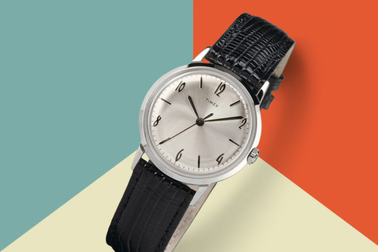 Some years later, an employee of mine suggested that we should consider selling the Timex line. I looked over the models and thought that there were a number of pieces in the collection that would certainly find favor in the store. We could say “from Timex to Rolex… The Last Wind-Up has watches for all”. Needless to say, with a bit of work, we managed to secure the account, and as a token of appreciation I sent the one non-sequential “Last Wind-Up” model from 1996 to the CEO with a letter extolling my passion for watches that “tick” and a recommendation that Timex get back into the ticking business. A couple of months had passed and I’d heard nothing. Strange, I thought. Then one day last month, we discovered that Timex was issuing a new hand wound timepiece again. It was a throw-back to the 1960’s called the Marlin. Simple, elegant lines and, not to be too cheeky, an engaging timepiece of modest proportions. I immediately contacted my representative from Timex and asked if I could stock the model. In the spring of 2018 the watch will be available to brick and mortar retailers. I was hoping to catch the wave… but will have to wait for the next one. A few weeks passed, and then a package arrived in the mail from Timex. One Marlin… and a gracious note from the CEO thanking me for the last “Last Wind-Up” and assuring me that Timex has a lot of great things planned for the future. I can’t wait! Below are just a few tidbits borrowed from Wikipedia… interesting horological trivia:
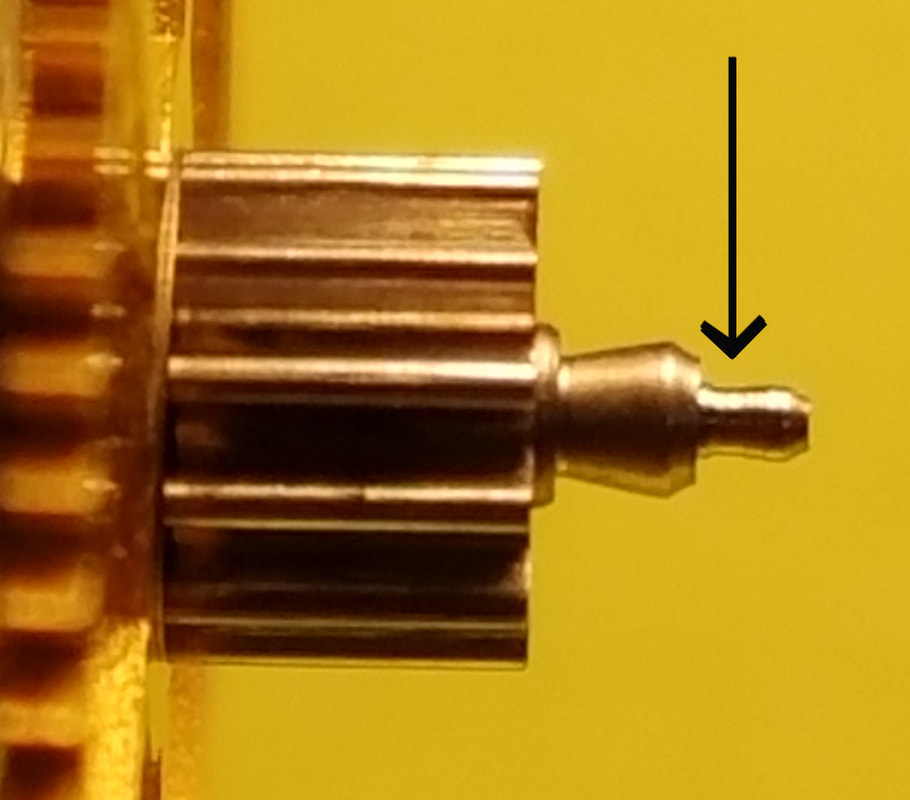
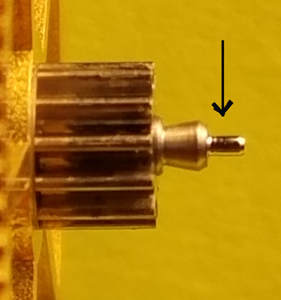
-In 1962, the Timex brand held the number one market share position in the United States where one out of every three watches sold was a Timex. -United States Time (Timex) was the exclusive manufacturer of all Polaroid cameras worldwide through the 1970s, totaling more than 44 million cameras. -In 1992, Indiglo made headlines as a result of the 26 February, 1993 World Trade Center bombing, in which an office worker wearing a Timex with an Indiglo night light used its light to guide a group of evacuees down 40 dark flights of stairs, causing sales to immediately take off, leading to an increase in Timex's U.S. market share. I’m often puzzled by the trends of watches. In the 1950’s, men’s watches were humble, a delicate 30-32 mm in diameter. Ladies watches were diminutive. Today, we live in the Texas way. Bigger is better. But I think the trend is shrinking. We often service watches that were designed by someone with very little forethought. Imagine putting lug nuts that were designed for a 1920 Ford on a modern Subaru WRX. Under scaled. Even in the 1940’s, Rolex and Omega were putting spring bars to secure the strap or bracelet that were very adequately proportioned. All too often I find watches with HUGE 40+ mm diameters secured with spring bar pins that are 1.2 mm in diameter. Where did these designers learn their trade? In short, you get what you pay for. About 6 months ago, we saw a post of a new Oris model of great retro design. Not only is this watch a great representation of what a watch would have looked like in the early 1900’s, but it also encompases all of the mechanical attributes that makes the watch a true heritage piece for any collector or aficionado of true historic timepieces. Built and designed with great historical and mechanical integrity but with all the characteristics to make a great everyday wearing watch for someone who appreciates the finer things in life… the ticking of a mechanical, self winding timepiece. Many early Swiss pocket watches were stem wound and pin-set. By depressing the pin on the perimeter of the case, while simultaneously turning the crown, the hands can be set to the correct time. Simple, elegant and engaging. In an effort to be true to the historical integrity of this limited edition model (1917 pieces worldwide), Oris captured the essence of true a true 1900’s timepiece without sacrificing any modern advancements. The Last Wind-Up has been offered two Limited Edition 1917 pieces. Numbers 10 and 11. I thought it nice that we were offered number 11 as we’re at 11 East Main Street in Bozeman. These two pieces are embellished with traditional leather straps… those that were often transitional ladies pendant watches converted to gentleman watches as a result of WWII. When in the trenches, who would want to fumble around in a pants pocket to produce one’s timepiece? How much more efficient would it be to be strapped to the wrist? Prior to WWI, wristwatches were considered effeminate, but not this re-issue. It’s an impressive and handsome sized watch. The leather strap, secured with formidable spring bars also has a removable “undergarment” leather fitting to keep the watch slightly off the wrist. With only an hour and minute hand, the watch speaks of a time long ago….a simpler time, when one’s day was not measured by seconds. When it all boils down, what parts of your life are measured in seconds? 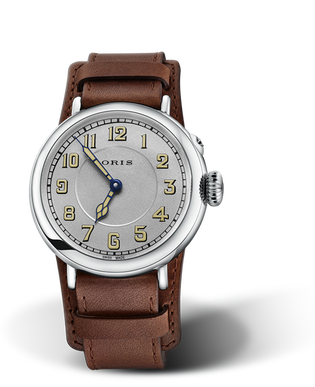 I’m often asked how frequently a watch should be serviced. This kind of depends upon the watch. In the early 1900’s, watches were lubricated with natural oils, often refined whale oil or porpoise jaw oil. Due to their organic nature, they would break down a lot quicker than modern oils that are synthetic. Consequently, watches had to be serviced on a much more regular basis….every year was not uncommon. Additionally, many watch cases were not nearly as dust resistant as they are today. So between dust and lint particles getting into a watch mechanism as well as natural oils breaking down, the watchmaker was kept pretty busy with a regular flow of watches. Knowing that many of my customers don’t have a watchmaking background, I often opt to the analogy of the car. Most manufacturers recommend changing the oil and filter every 3000-5000 miles. This is because the viscosity of the oil starts to break down and the oil also begins to take on engine particulate. A car will not run as efficiently or maintain a long healthy life if the oil is not changed on a regular basis. The same holds true for a watch. Below is the center wheel from an American pocket watch, ca. 1900. The pivot (bearing surface) in the image on the left is what happens when the watch has not been cleaned regularly. This pivot was running in a brass bushing (much softer than the hardened steel pivot) for so long with inadequate lubrication, that the steel pivot was worn down significantly enough to almost render the watch unusable without repair or replacement parts. The image on the right shows the same pivot after it has been burnished down in a lathe to attain proper shape. Consequently, the bushing for that pivot also had to be closed to accept the now smaller pivot.
The tick of a mechanical watch is a jewel hitting the escape wheel. In many watches, that happens more than 80,000,000 times a year. If not properly lubricated, there will be wear and tear and the cost of servicing the watch will begin to rise.
As a general rule of thumb, I recommend that a watch be serviced every 5-7 years. More regular maintenance would be assure a longer life to the watch but is not absolutely necessary. And some manufactures suggest this. And certainly, if your watch starts to exhibit erratic timekeeping, it's a good idea to have it looked at and possibly serviced. One thing that I’ve learned over the years is that a strap or bracelet on a watch can make or break the look. It's not unlike wearing the right tie with the right shirt or sport jacket. But not only are looks important, function plays a big part when choosing the right accessory for your watch. Not that I’m terribly style conscious, but some things just seem to pair better than others.
When it comes to watches, it's all about personal taste. Both fit and form can turn a simple watch into a truly exceptional piece or a veritable train wreck on the wrist. When buying a watch, try to envision what it would look like with a different strap. Or better yet, ask your salesperson to see what other straps might look good on the watch in question. Metal vs leather vs everything else - Metal bracelets - Gold, steel, titanium or a combination of either have benefits and some drawbacks. Gold, either 14K or the softer 18K, will look great but if not cared for with regular cleaning will wear faster than other metals. Generally, it is the particulate that gets caught between the links that acts as an abrasive, causing excessive wear and tear. Then the links appear to stretch and the watch becomes sloppy on the wrist. In extreme cases, the watch might even fall off. Steel is a great material for a watch bracelet. It wears well, can easily be refinished to look like new and is anti corrosive. Titanium is another wonderful material for watch bracelets - very lightweight, extremely tough and lasts for years with little maintenance. Leather straps come in a huge variety of sizes, colors and finishes. There are two basic varieties, genuine and embossed. Genuine straps are those like alligator, crocodile, shark, ostrich. These straps show the actual grain of the particular species. Then they can be dyed to a variety of colors to compliment the particular look of the watch. Embossed straps, generally a lot less expensive, are made from cowhide and are embossed or printed with a pattern that resembles a genuine strap - lizard, crocodile, etc… and the color range is almost limitless. In most cases, genuine straps will cost more but will last longer. Some genuine and embossed straps are treated to be water resistant. These will generally last longer than untreated ones if exposed to a lot of moisture. Contrasting stitching or same color stitching, padded or flat, high gloss or matt finish can all change the appearance and look of your watch. The last category contains nylon, silicone, rubber, plastic, goretex etc… straps tend to be more conducive to sport type watches and those subjected to water on a regular basis because they don’t absorb moisture and stay flexible for years of use. NATO style straps have become increasingly popular. One of the great advantages to this style of strap is the security of the watch. One-piece design straps secure the watch to the wearer with two spring bars. If one of the spring bars were to fail, then the other holds the watch to the strap. This is not the case with two piece straps. One last note - clasps. Today there is a huge assortment of clasps available for two-piece straps. Deployant type clasps offer a simple metal closure that makes putting on and taking off the watch very easy. There are single fold-over, double, butterfly and others. There’s no reason to stick with the traditional “buckle and tang” style with the variety that is available today. At the Last Wind-Up, we offer a wide variety of watch straps, bracelets and clasps. Hadley Roma, Hirsch, Montana Strap (locally made). Whether you are simply replacing an old worn out strap to your sport watch or trying to dress up a new or vintage watch, we’ll ensure that the strap has the right fit to address your personal lifestyle. One of the benefits of having a store that offers new and pre-owned items is that we get to see a huge variety of wonderful watches. Not just the ones by the famous makers that get our blood pumping (but it helps), but the the ones that come to us with a tale to tell. I often wish I had more time to delve into the personal history of these particular pieces as they would make for great stories. Here’s my foray into PBS’s Antique Roadshow (and I’m proud to be a sponsor).
There are many items that fall into the “family heirloom” category. It could be a book, or a signature from a famous baseball player. It could be a chippendale chair, a stuffed animal or a vintage car. But what intrigues me most are those watches that were carried or worn by the family member of a past generation. Their diminutive nature, purposefulness and life.... the ticking, manual engagement that was (and is still) required, is so full of personality. These timepieces were, for the most part, monies well spent….an investment and a faith in the future. The general consensus could be deemed reasonable then as it is today: “Pay for quality and it will repay you with longevity.” Once in awhile, I’ve purchased a tool for my trade and been wholeheartedly disappointed at its quality. Would this be something I’d want to pass along to my next apprentice? No. But a tool with great attention to detail and understanding of purpose, yes! Such are the watches that are well made… be they from the early 1900’s or the early 2000’s. You get what you pay for. Two watches came into the shop last week under totally different circumstances, but both with customers in need. The first was a wonderfully well-preserved Rolex Red Submariner, in immaculate condition with (according to the original purchaser) all the goodies: box, papers, receipts etc... It was graduation weekend at Montana State University and the mother was having the ca. 1970’s Rolex fitted to her graduate’s wrist. We were MOST happy to oblige. As their emotions made clear, the passing on of this timepiece was significant to both the mother and her son. The second watch came in and it blew me away: a Patek Philippe pocket watch. This particular piece was a minute repeater with a split second chronograph. I was only asked for a rough valuation and a lesson on its operation. It just so happened that the customer’s elder relation was in the horse racing business and the following day was significant race - nostalgia hard at work. Two pieces each worth significantly more than my 3 year old truck, brought into my business for my expertise. I’m privileged to be entrusted with adjusting and appraising such items. Both of these pieces were mechanical, utilitarian, artistic and horological masterpieces of their day, and both were resurrected for a new life experience. A college graduation present purchased new in the 1970’s now offered to a deserving student and a descendant of a well deserving horse racing individual who might be celebrating an anniversary equine race. Who really knows what these pieces mean to the givers or the recipients….but it is the fact that they are passed down, as symbols of all that they meant to the original owner. The 2017 Basel Fair, an annual horological pilgrimage, wraps up in a few days. So far it is a LOT of fluff, but for the watch junkie, it is also a lot of eye candy. Take, for instance, the new Rolex Yachtmaster (seen here via Hodinkee). In my humble opinion... what were they thinking? I’ve read some of this model’s reviews, within 48 hours of its debut, accentuated with words like chiclets, unicorn vomit, Easter and even, “I like it.” Sorry, not sure for what event, or even on what planet, this would be an accessory worn by any self-proclaimed “made-it” kind of Rolex personality. Be that as it may, we’re all entitled to our own opinions. This one I fear is destined for only those willing to take a super huge bet of the leveraged hedge fund variety, and only were it on Oct. 31st just to say “I’m that outrageous”.
I’ve attended the Basel Fair in 2009 and it was awesome. I met some wonderful people, saw some fantastic and innovative watches, tools and everything in between. It was an exploratory endeavour and it fed my horological belly with lots of vitamins and fervor. These days though, I’m happy to offer my smaller non-corporate brands - Oris, Momentum, Boccia, Marathon - and a plethora of vintage pieces from notable American, Swiss and other countries. The business model I’ve chosen, albeit not written in stone, urges me to provide my customers with family brands, ones that an individual in the market for a new watch would not find at Costco or on some grey market website with lackluster customer service. Let’s be real, with a cell phone in the pocket, who needs a mechanical watch? Well, I’ll be the first to extol the virtues of something that ticks, something that can be maintained for decades by a competent watchmaker. Many of the watches that come to my bench for repair or restoration are family heirlooms. Are they worthy of such maintenance? In most cases, absolutely. This week, two Hamilton 992B railroad watches were received and offered service. One needed a full service and a balance staff replaced. The other, having been serviced by me only a few years ago (and since dropped by the owner’s grandchild) needed a balance staff, but retained a regulation that was impecable. Seconds a day error in all positions. As much as I love seeing new innovations and cutting edge technology (see a future post of a wristwatch case using 3D printing), there are some things that tradition and old-school watchmaking can not diminish. And I am pleased to be a part of the maintenance of such well-made pieces of horology. The Basel Fair does showcase some wonderful new models, and I’ll admit, I fell for one today (to be delivered in September), an Oris 1917 seen here. Some things never change. With a myriad of ways to kick off the new website including thanking web designer Danny for being so persistent, I thought I'd create the first journal entry by offering somewhat of an introduction to not only a favorite book, but also a very dear associate. Watchmaker Barry Marcus and I have not met, nor had we even spoken on the phone until just a few weeks ago. He called with great concern, offering a sincere warning about expired watch batteries, both lithium and silver oxide. Under certain circumstances, these batteries can heat up or even explode, with the potential for a fire. That's just the kind of guy Barry is. I get a thrill with every email. I also get a jolt of reinforcement in the path that I've taken. And all too often, I come away with some tidbit of wisdom from a watchmaker who has been at the bench since he was 11. He's now in his early 80's.
The book, co-authored with his daughter Julie Campisi, Watches I Have Known, is a sociological collage of the people (family and customers mostly) who have engaged Barry Marcus throughout his long career. The stories weave one through the emotional spectrum because it is not about the watches, it is about the people; their stories and how their lives were changed, made important or otherwise effected by the kind spirit of a watchmaker. The watches are the thread that hold the cloth of this endearing book together. The fabric is Barry and the people he writes about. The short vignettes offer the reader a chance to peer inside the world of the watchmaker from a mostly non-technical vantage. Stories run the gamut from military veteran watches being passed down and finding their way into combat again (after the caring repairs of Barry) to watches with inscriptions of past loved ones, important occasions and the like. Watches I Have Known is a must read for anyone with a love of humanity. An appreciation for watches certainly helps. The symbolism and emotional connection watches hold shines throughout the book. Barry's passion for his craft is clearly evident, as is his understanding and appreciation for a treasured timepiece. That heirloom that might be worth very little monetarily, but everything to the owner.... and Barry Marcus knows it. |
Author
Archives
April 2024
Categories |
 RSS Feed